
Company Death Mediation: A win-win practice
Fear of job loss or going bankrupt? That fear can be a powerful teacher, win or lose. Tony Robbins and the Dalai Lama prescribes it. Here is how I learned the hard way.

When my company died last month, I was already halfway through the funeral. Not because I’m insensitive or a psychopath, but because I had practiced.
Now, approaching mid-2025, many companies are dying. Many are being laid off, facing the death of their work - their roles.
This isn’t just business as usual. It’s emotional. It hits our identity. Asks us to face loss, uncertainty and unfamiliar kinds of adversity.
Since my first LinkedIn post about this, and in nearly every conversation since, I’ve noticed something: most people assume I’m devastated or broken. I’m not.
That’s why I want to share my practice of Company Death Meditation.
You might feel discomfort as you read. If you stay with me, I’ll explain. I’m even bringing support for you.
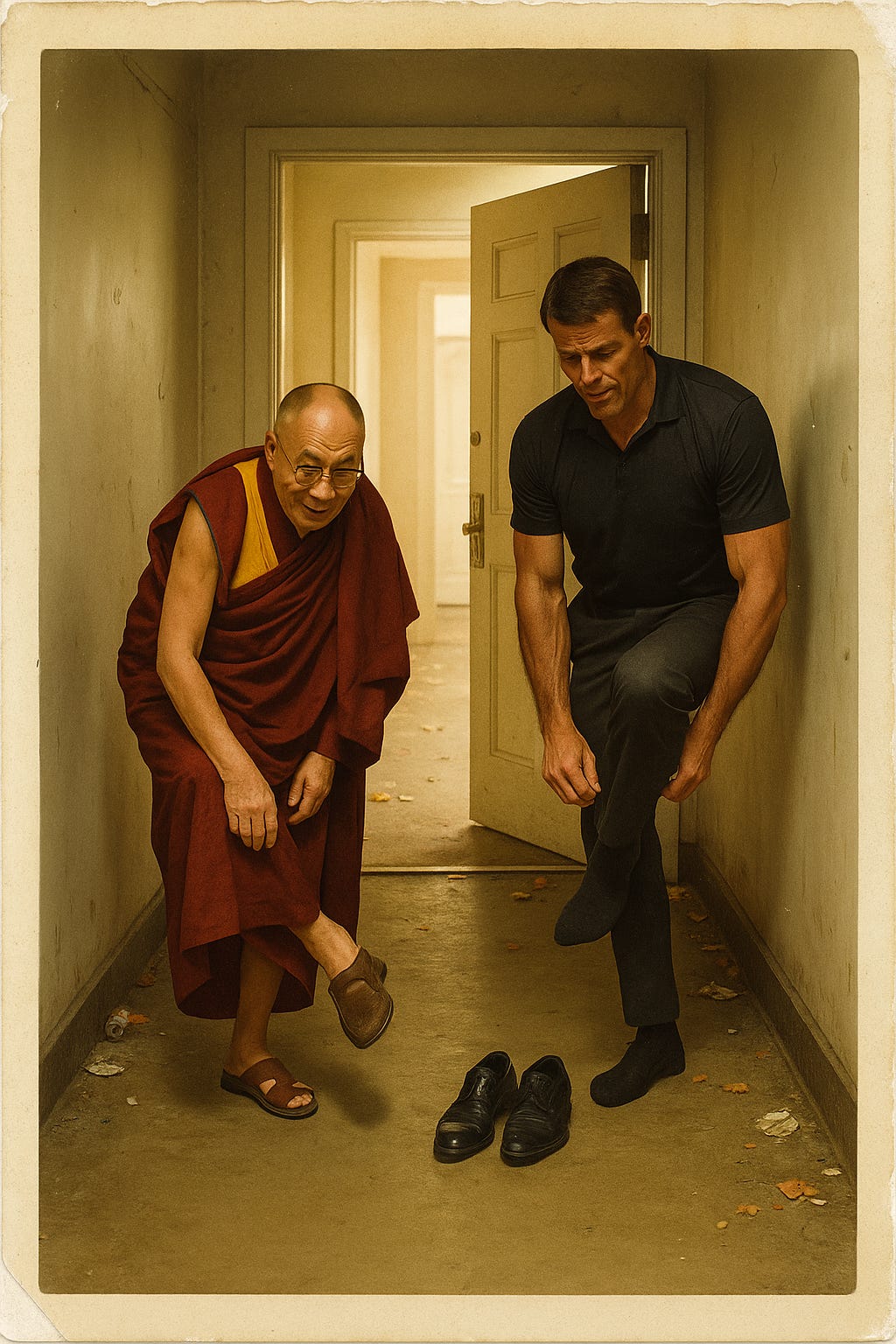
It did not come for free
It wasn’t deep intelligence or heroic effort that prepared me for my company’s death. It was a long chain of what, at the time, felt like burdens—suffering that happened to build resilience.
Entirely involuntary.
As CEO of a startup bootstrapped for far too long, I lived on the edge of shutdown—again and again. But each time, we managed one more lap: raise a bit more money, build one more feature, prove one more KPI.
But startup culture doesn’t teach you to consider the downsides. In fact, it teaches to preach and live the upside.
Following my mother through ten years of Alzheimer’s was a different kind of teacher. That disease—when faced clearly—forces you to feel, and eventually to accept decline. My meditation practice helped.
I wouldn’t have practiced meditation if not for a severe illness—one that forced me to find ways of coping with physical pain.
And I wouldn’t have had that illness if I hadn’t started my first company, run marathons, and had a baby with nine months of colic—thinking I could give 100% to all of it. Everything is possible. Until it’s not.
The whole point is: everything is conditioned by what came before. Events aren’t good or bad. It depends on how you frame them.
This backdrop prepared me—somewhat—for the eventual collapse: the loss of my company, my work, my professional identity. But even that wasn’t enough. I needed more adversity to truly begin the practice.
About a year ago, after resolving yet another critical phase for my company —new board, fresh investment—I got the call. My father had been found collapsed in his house in Spain. I dropped the investor calls and booked a flight.
His brain hemorrhage was fatal. But we were granted seven days by his side before he passed.
For those seven days, and some to follow, I practiced actual death meditation—supported by extraordinary teachers. It remains one of the most beautiful, profound experiences of my life.
You can do it, and you probably should
Given this context, it feels a bit unfair to ask you to explore this practice, as I know how hard it is. I’ll give you a breather and connect back to our success-focused business culture for a moment.
“Everything is possible.” Visualize your success. Set your goals. Repeat them daily. Visit the Lamborghini showroom. Touch your future!
Okay. Feeling better? Still with me? Good. Let’s build a bridge from the hype to the heart of it.
Tony Robbins, the original coach to the stars, has always preached one thing: to grow, you must face your fears. And what’s the ultimate fear? Death. He’s just packaging the uncomfortable into a commercial-emotional sales funnel.
The Dalai Lama meditates on dying every day. Yet his presence radiates kindness, calm, and compassion. He packages the same discomfort—but in a spiritual tradition.
Every success story you’ve ever admired contains a near-death, transcendent moment.
If death and success are always intertwined—why aren’t we preparing for success by practicing the opposite?
So check in now: how do you feel about actually doing that?
Do you feel resistance? That pull to scroll away? A twitch toward something easier—another hit of success memes or productivity hacks?
Feel that resistance. Hold it—like you’d hold a baby.
You are on the right path! That resistance? It’s the first step.
Now switch from mothering-hold-baby-mode of your feelings, envision Tony Robbins screaming to your face, and f-ing push on. Bring your baby.
The most daring thing to practice
Western culture doesn’t train us to contemplate death—or even talk about it. Yet in most contemplative traditions, it’s considered a virtue.
Look it up: Stoics, Buddhists, theologians—they all go there. The Stoics, by the way, had a technique for facing resistance head-on. It’s called premeditatio malorum—the premeditation of evils. In simple terms: worst-case scenario practice.
Try it now. Here are my top three worst-case scenarios:
One of my kids becomes terminally ill. (I can’t go there.)
My wife becomes terminally ill.
Our family breaks apart.
Now, for just a moment—imagine the worst thing that could possibly happen to you. Really feel it.
Then come back to something simpler: losing your job, your company going bust.
The point is to practice the uncomfortable—because practice makes it easier to relax with discomfort. But to do that, you need to find your boundaries.
If you go too extreme—like I just did—you’ll likely shut down. Your mind blocks it. No emotional signal gets through. And the practice stalls.
That’s how you find the edge. You’re looking for a real emotional response to your strategic doomsday game.
This is the same kind of simulation the Stoics recommended. And it’s the same structure behind what makes Tony Robbins’ events so impactful: setting the stage for emotional intensity in a context of safety. Strategic rehearsal with emotional charge.
It’s the same psychology behind “visualizing success” by visiting the Lamborghini dealership. That can actually help—if you’re someone who gets visceral feelings from touching a yellow car.
It’s just a simulation
Give yourself permission to go deep into what most people would call “negative self-talk.” Remind yourself: it’s not. This is strategic simulation. A tool for learning—and feeling.
And remember: it’s just a job. Just a company. Just like money. It’s not really real. Just ideas.
Like prompting an AI, you’re feeding the system with parameters—except here, you’re the system. You give yourself permission to explore a loss scenario, but with a boundary: no silver linings. That’s a different practice. This one is just about the death part.
Every morning, the Dalai Lama meditates on his own death. He does it like an athlete—like a fighter pilot running through flight stages. He enters deep concentration and visualizes, step by step, the progression of dying. He’s a master at this, and I won’t go into the specifics.
What matters is: he starts at “I’m alive, possibly suffering,” and walks himself all the way through death.
A Tony Robbins event is its own kind of mass simulation. Music, lights, guided stories—carefully designed to stir emotion and create a container of safety. Then: jolt. Face your fear. His persona screams success. The show has megachurch energy.
But underneath? It’s about freeing yourself by resolving fear through immersion.
We’re doing the same thing here. DIY-style.
Except we’re not simulating euphoria—we’re aiming for “bad” emotions. That’s the point. So let’s go.
You’re losing your job. You’re going bankrupt. Visualize:
What event triggered the death spiral—before you even realized it was final?
What made you finally accept, “OMG, this is happening”? Where are you? Who do you tell?
How do your coworkers react? What do they say? How do they feel?
How do your investors, customers, or partners react? Are they angry? Supportive?
How does it affect your family? Do they worry? Feel uncertain? Cancel a holiday?
What practical things must you handle up to the end?
What’s the final email you send, the last paper you sign? See yourself logging off, creating a new account.
What do you tell your friends? What’s the story you give them?
How do you feel about you—without the company, the job?
How do you care for yourself in that moment? What do you need?
Try not to drift into what’s next. Don’t start imagining the comeback or the new chapter.
That’s not this practice.
Instead, move back and forth through the death process. Look for emotional response cues. Stay with them—until you sulk, cry, or notice the shadow of depression. That’s the point:
To experience the adversity. Then let go.
It was just a simulation.
Congratulations—you’ve just built neural networks that make you more resilient.
The silver lining
That resilience doesn’t arrive with fireworks. First, it’s just a softer, less panicked feeling about adverse outcomes. Then maybe—if you keep practicing—you start noticing small openings, tiny silver linings in the middle of things going wrong. Eventually, you might even come to believe that whatever happens could be just fine.
Alan Watts often retold the old Taoist parable of the farmer who faced a string of unpredictable events—his horse ran away, then returned with wild horses; his son broke his leg, which later spared him from war. Each time, neighbors exclaimed, “Such bad luck!” or “What good fortune!” And each time, the farmer simply replied, “Maybe so, maybe not.”
The point, Watts explained, is that events aren’t inherently good or bad. It’s our rush to label them that creates the noise. Real clarity comes—if at all—only with time.
As my company hit challenge after challenge, I kept practicing: I may not be able to resolve this one.
Gradually, I started asking myself the simulation questions—and listening for the emotional response.
It didn’t make me numb. Or cynical.
It made me calm.
It made me take better decisions. But as I approached the company’s actual death, I noticed something else: most people around me were not on my wavelength. Communication got really difficult. Lots of stress.
I don’t mean I wasn’t stressed—I was. But all in all I didn’t panic. I didn’t spiral. I didn’t lose sleep.
While I had a sense of acceptance, I could feel the tension around me tightening. People growing more constricted. I worried I’d come off as superficial, or worse—indifferent.
It reminded me of the villagers again.
They were crying, “Such bad luck!”
And I was the weird one, standing there saying, “Maybe not” when the house was on fire.
The silver lining is that what you simulate might very well not happen. If it doesn’t then you have not wasted your time. You have not been “pessimistic”. What you gain is a healthy distance, a softened attachment to your job or company, which will make you more daring, free and fearless in making necessary decisions.
If you can live with the simulation of your house burning to the ground, then an actual event of the outhouse burning, won’t bother you, and you’d rather focus on securing an insurance payout and enjoy the remodelling of your garden instead.
In my case, the house kinda burned down, and honestly, even now—as I write this, still surrounded by echoes of “Such bad luck!”—there’s discomfort, doubt, uncertainty, even some shame. But I’m not attached to what was.
And that, I’m sure, will guide me faster toward whatever comes next.
Unwelcome, but still your guests
I’ll end with one last story—which is also a tool. The one about uninvited guests.
Imagine you’re at home, and suddenly your living room is full of loud, obnoxious strangers. They weren’t invited. They’re shouting, spilling drinks, breaking your mother’s favorite vase.
You try yelling at them to leave—but that only makes things worse. They get louder. Meaner. More chaotic.
So what do you do?
You open the door again—but not to force them out. Instead, you look outside. Who else could you invite in?
Maybe Curiosity is standing there. Maybe Gratitude. Maybe Mrs. Leah R. Newthings?
You call them in and let them sit beside you in the chaos. No need to evict the noise, just need to stop giving it all your attention.
This strategy works. Look it up—ACT, CBT, countless forms of therapeutic exposure. The key isn’t to fight the bad guests. It’s to create a room for better energy.
So when adversity shows up—if the layoff lands, or the business burns—if you’ve practiced, something shifts.
The time it takes to open the door and let someone else in will be drastically shorter. You’ll suffer your uninvited guests a lot less.
And who knows?
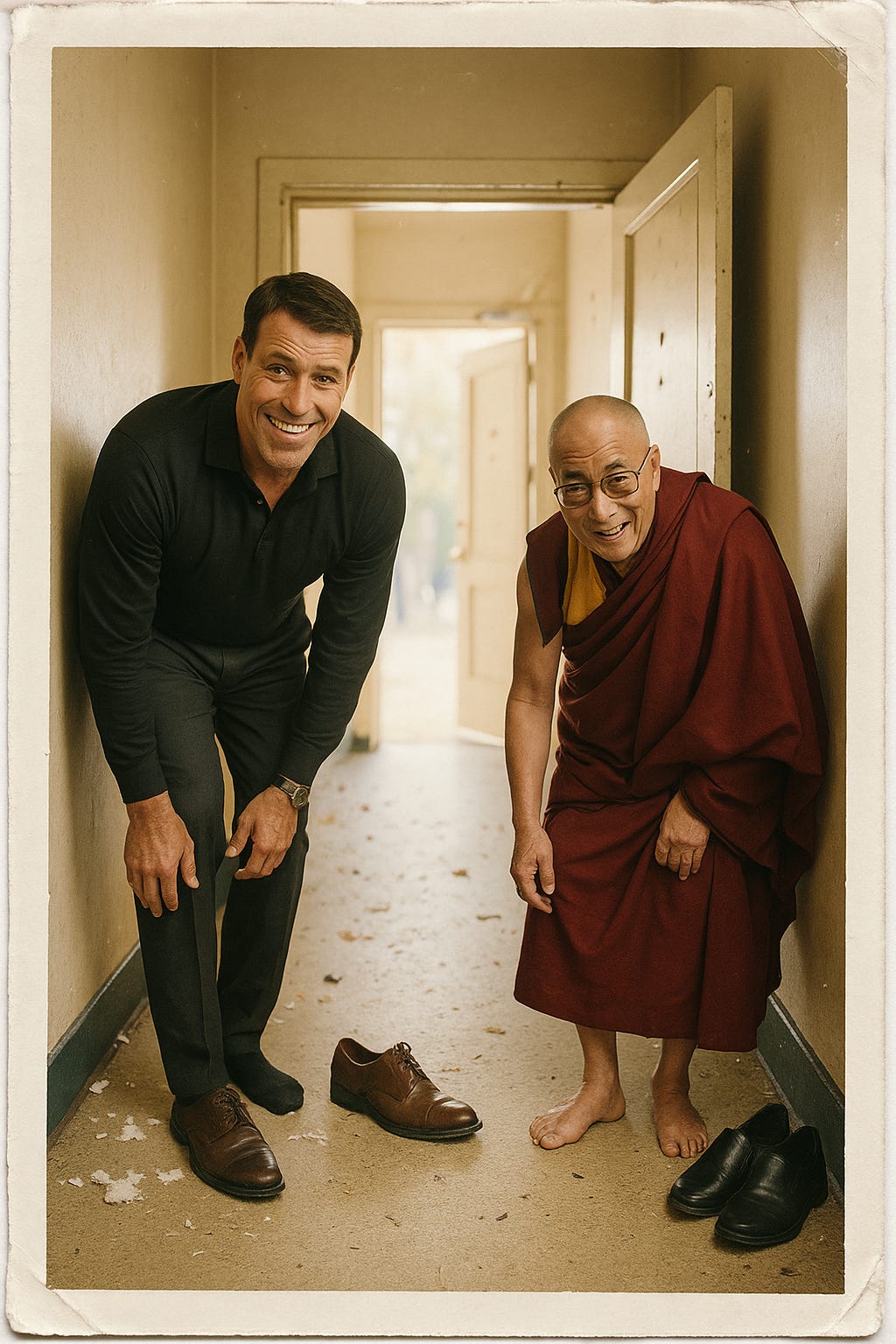
Maybe it’s Tony Robbins or the Dalai Lama standing outside when you open it. Maybe they’ve brought new furniture.
“What good fortune!” the people will say
.